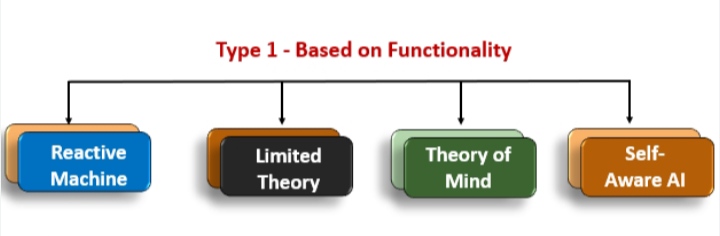
The primary objective of such AI built systems is to perform some specific function. These are further classified into following sub-categories of Artificial Intelligence.
- Reactive Machines
- Limited Memory
- Theory of Mind
- Self-Awareness
Let’s explore the types of artificial intelligence classified according to functionality in detail.
AI TYPE – BASED ON FUNCTIONALITIES –
1. REACTIVE MACHINE –
Reactive machines are the oldest form of AI, and they have limited capacities. These machines don’t have memory-based functionality. Therefore, reactive machines lack the ability to make decisions based on previous experience. Essentially, they only work with present data and cannot learn. This means their future performance does not improve with practice.
They are given specific tasks and don’t have capabilities beyond those duties. They’re what you’re most likely to see when witnessing a robot playing a game, like chess, against a human. But reactive machines don’t interact with the world, so they respond to identical situations in the same ways every time those scenarios are encountered.
An example of a reactive machine is perhaps the most famous AI system – IBM Deep Blue, a chess-playing supercomputer that defeated international grandmaster Garry Kasparov.

Deep Blue understands the rules of chess. He recognizes all the pieces on the chessboard and knows how each of them moves. He can predict the next move for himself and his opponent, and his movements are optimized – by analyzing the current situation on the board, he makes the best one.
However, Deep Blue has no memory of previous chess games. Everything before the present moment does not exist for him. His decisions are based on the current situation and options.
2. LIMITED MEMORY –

Limited memory consists of machine learning models that extract knowledge from previously learned information, facts, stored data or events. As distinct from reactive machines, limited memory is able to learn from the past by analysing actions or data given to them with the purpose of building probationary knowledge.
This type of AI is employed by virtual voice assistants, chatbots, self-driving cars, and several other technologies.

Autonomous vehicles, also known as self-driving cars, use limited memory technology that relies on a combination of observationally gathered and integrated knowledge. Their ability to drive and function adequately among human-reliant vehicles comes from analysing their environment, detecting patterns or alterations in external factors, and adapting as required.
Self-driving cars don’t just monitor their environment, but also take into account the movement of other traffic participants found in their line of sight. Its software analyses the data and decides on adapting the speed or choosing the direction of the vehicle. In the past, autonomous vehicles without limited memory AI needed up to 100 seconds to react and make decisions based on external factors. After the implementation of limited memory, response time on machine-based observations has decreased tremendously, showing the value of limited memory AI.
3. THEORY OF MIND –
Theory of Mind refers to the capacity to understand other people by ascribing mental states to them, surmising what is happening in their mind). These states may differ from one’s own state and include beliefs, desires, intentions, emotions, and thoughts.
This is currently the third level of AI and understands the needs of other intelligent entities. Machines aim to have the capability to understand and remember other entities’ emotions and needs and adjust their behavior based on these, such as humans in social interaction. This is ongoing AI and needed to be implemented.
4. SELF AWARE AI –
The final type of AI is self-aware AI. This will be when machines are not only aware of emotions and mental states of others, but also their own. When self-aware AI is achieved we would have AI that has human-level consciousness and equals human intelligence with the same needs, desires and emotions.

At the moment, this AI hasn’t been developed successfully yet because we don’t have the hardware or algorithms that will support it. When we do, will this artificial superintelligence (ASI) make it possible for machines to take over the world as some ponder? Or will they help create and collaborate with humans? Perhaps this won’t even be the pinnacle of artificial intelligence and we will discover there is a fifth type. Time will tell. Until then, AI researchers will continue to enhance limited memory AI and work to develop theory of mind AI.
This AI is yet to develop, and if it is incarnated, we will surely witness a robot with human-level consciousness and intelligence.
ADVANTAGES OF AI
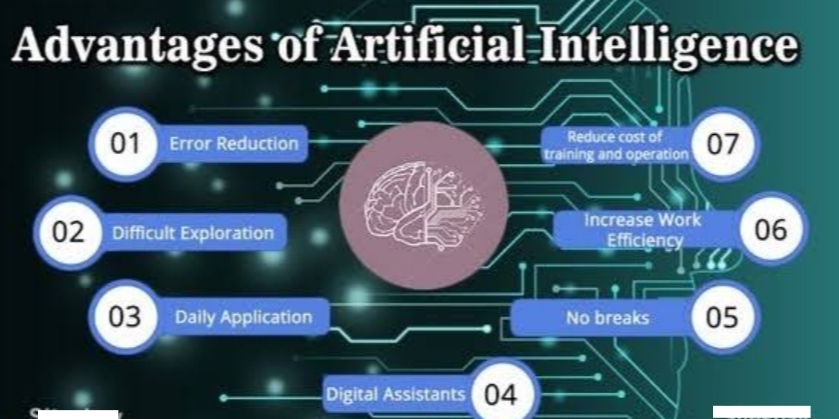
1. Error Reduction –
The first major advantage of implementing AI is that it decreases human error, as well as risk to humans.
Everyone makes mistakes on occasion. That’s not always a bad thing, but when it comes to producing consistent results, it certainly can be. Using AI to complete tasks, particularly repetitive ones, can prevent human error from tainting an otherwise perfectly useful product or service.
2. Difficult Exploration –
Similarly, using AI to complete particularly difficult or dangerous tasks can help prevent the risk of injury or harm to humans. An example of AI taking risks in place of humans would be robots being used in areas with high radiation. Humans can get seriously sick or die from radiation, but the robots would be unaffected. And if a fatal error were to occur, the robot could be built again.
3. Daily Application –
Apple’s Siri, Google Now, Amazon’s Alexa, and Microsoft’s Cortana are one of the main examples of AI in everyday life.k AI can be used along with the vehicle’s camera, radar, cloud services, GPS, and control signals to operate the vehicle. AI can improve the in-vehicle experience and provide additional systems like emergency braking, blind-spot monitoring, and driver-assist steering.
4. Digital Assistants –
By using digital assistants, a business can: Offer more services. Businesses can provide more services to their employees and customers by using chatbots to handle the more routine help desk or customer service requests. Save money.
5. No Breaks –
A machine doesn’t require breaks like the way humans do. They are programmed for long hours and can continuously perform without getting bored or distracted. AI can work indefinitely without taking a break or vacation. Machines can think much faster than humans and perform multiple tasks simultaneously.
6. Increase Work Efficiency –
One of the key benefits of AI and automation is that it can automate manual tasks, freeing up employees to focus on more strategic and creative tasks. For example, AI-powered chatbots can handle customer service inquiries, allowing customer service representatives to focus on more complex issues.
7. Reduce Cost Of Training And Operation –
Another way of how AI improves the efficiency of a company is reducing operating costs. Operating (or operational) costs are expenses related to the core operations of your company. These costs depend on the type of business, but they can consist of the following components:
- Salary expenses
- Maintenance and repair costs
- Office rent
- Travel expenses
- Marketing costs
- Bank charges
- Office supply costs
- Costs of the production materials
DISADVANTAGES OF AI
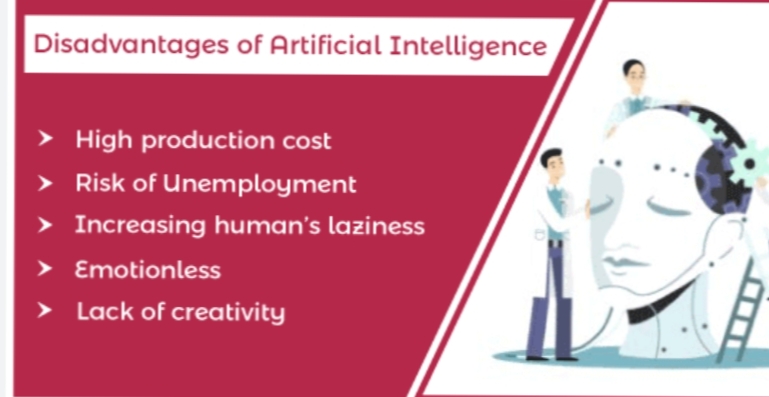
1. High Production Cost –
Training AI models requires computational resources, which come at a cost. In addition, maintaining an AI system requires both hardware and software resources, which also come with costs. The training of AI models is often done on GPUs, which are expensive.
2. Risk Of Unemployment –
One application of artificial intelligence is a robot, which is displacing occupations and increasing unemployment (in a few cases). Therefore, some claim that there is always a chance of unemployment as a result of chatbots and robots replacing humans.
3. Increasing Human’s Laziness –
AI applications automate the majority of tedious and repetitive tasks. Since we do not have to memorize things or solve puzzles to get the job done, we tend to use our brains less and less. This addiction to AI can cause problems to future generations.
4. Emotionless –
Neither computers nor other machines have feelings. Humans function as a team, and team management is essential for achieving goals. However, there is no denying that robots are superior to humans when functioning effectively, but it is also true that human connections, which form the basis of teams, cannot be replaced by computers.
5. Lack Of Creativity –
A big disadvantage of AI is that it cannot learn to think outside the box. AI is capable of learning over time with pre-fed data and past experiences, but cannot be creative in its approach. A classic example is the bot Quill who can write Forbes earning reports. These reports only contain data and facts already provided to the bot. Although it is impressive that a bot can write an article on its own, it lacks the human touch present in other Forbes articles.

Conclusion
AI is at the centre of a new enterprise to build computational models of intelligence. The main assumption is that intelligence (human or otherwise) can be represented in terms of symbol structures and symbolic operations which can be programmed in a digital computer. There is much debate as to whether such an appropriately programmed computer would be a mind, or would merely simulate one, but AI researchers need not wait for the conclusion to that debate, nor for the hypothetical computer that could model all of human intelligence. Aspects of intelligent behaviour, such as solving problems, making inferences, learning, and understanding language, have already been coded as computer programs, and within very limited domains, such as identifying diseases of soybean plants, AI programs can outperform human experts. Now the great challenge of AI is to find ways of representing the commonsense knowledge and experience that enable people to carry out everyday activities such as holding a wide-ranging conversation, or finding their way along a busy street. Conventional digital computers may be capable of running such programs, or we may need to develop new machines that can support the complexity of human thought.
 Study Live